
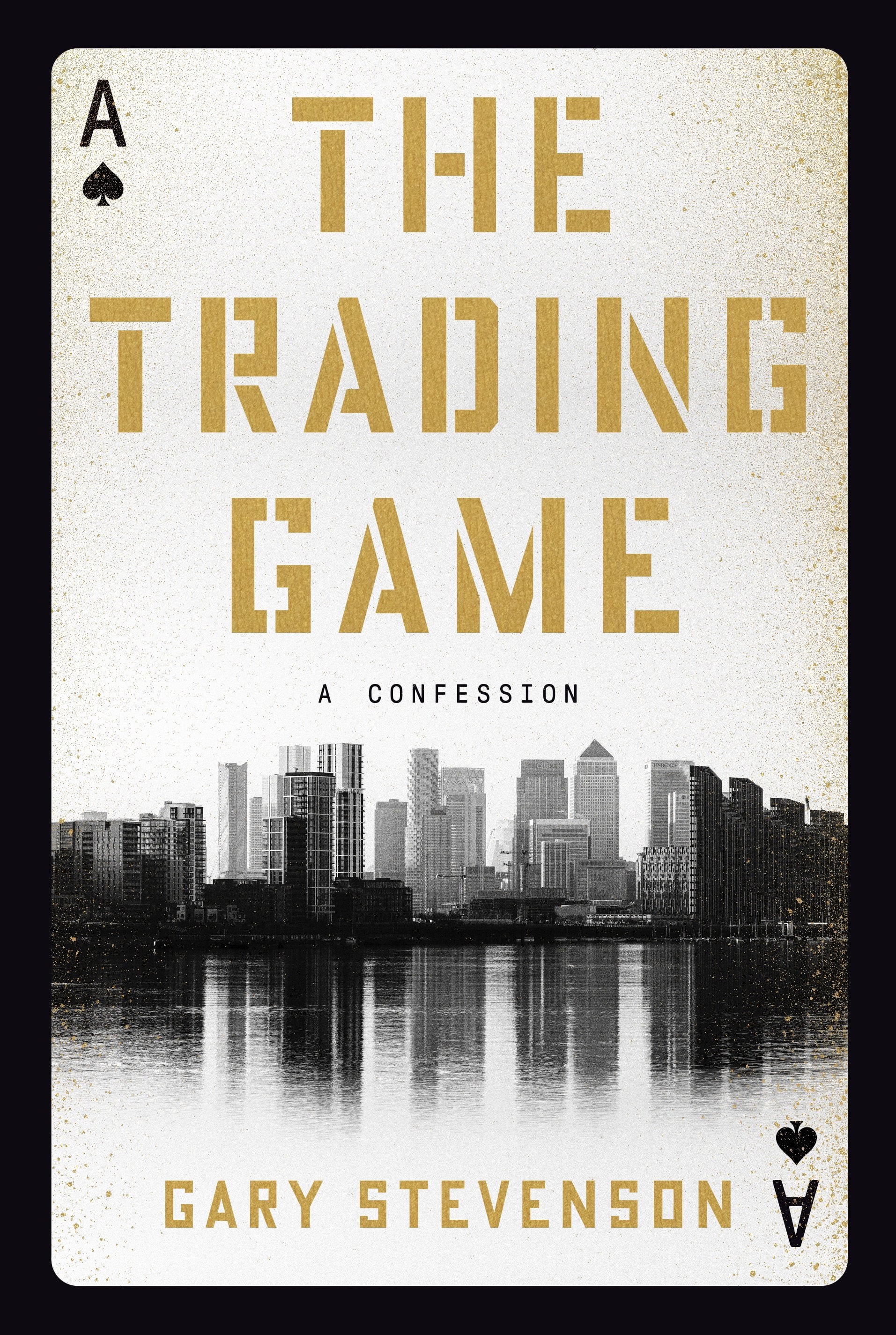
https://www.goodreads.com/book/show/188543465-the-trading-game
Gary Stevenson grew up in a very deprived part of London, then became a trader at Citibank. This is his story.
The book doesn't live up to the hype. The beginning is interesting, as it is the story of a poor kid, growing up near the financial district of Canary Wharf, who manages to land a job as a trader at a top American bank. After he starts his job, however, the narration quickly goes downhill.
Some praise Stevenson (who also has a youtube channel) as if he provided unique, profound insights into inequality, economics and finance. In my view, he does not; he rants about the economy being a zero-sum game (if you get richer someone else must get poorer) and about economists being out of touch (hardly very original thoughts), but doesn't offer any practical insight or solution.
The impression I got, which I found disturbing, was that the author was descending into a spiral of mental health issue of which he was and probably remains unaware, otherwise he would have described it differently; e.g. he goes to live in a flat without furnishing it, and other stuff I'd rather not get into to avoid spoiling the book.
Also worth mentioning that the Financial Times ran a story debunking many of his claims: https://archive.is/DguLm
Anyone interested in satire on the world of high finance could read the series (entirely fictional and absurd, that's the whole point of the books)
https://www.goodreads.com/book/show/19498301-at-bonus-time-no-one-can-hear-you-scream?from_search=true&from_srp=true&qid=QQCMHdCAZk&rank=2 or look at the comic strip https://www.alexcartoon.com/ which used to run in the Daiily Telegraph newspaper
For a serious, sociological / anthropological view at various finance characters:: Swimming with Sharks: My Journey into the World of the Bankers https://www.goodreads.com/book/show/26033666
For an account of the great financial crisis: The Big Short and Boomerang: the Meltdown tour by Michael Lewis
by not_who_you_think_99
6 Comments
> and other stuff I’d rather not get into to avoid spoiling the book.
Why, does this nonfiction book contain any shocking plot twists?
IMO it’s a pretty great book. Well written, great stories told in a funny way. It’s an autobiography and should be treated as such. He touches on some inequality type stuff but that’s just his opinion and thoughts, not a deep dive into the subject, because again it’s an autobiography.
As someone working in high finance I related to some of the ridiculous stories and characters he worked with. That and some light heartedness is what I appreciate most about the book
Gary has written a fantastic book. As a non-economist, I found the pace and content clear and compelling. I have a better understanding about why our country is getting richer everyday, but all our public services are crumbling, my property is now worth a fortune but salaries have stagnated. Of course, when an average working-class person points at the super rich and powerful and demonstrates that they are the problem and by taxing them, it’s the solution, instead of the problem being blamed on nurses and single-mums, the rich and powerful attack him. But you don’t need to get angry or upset that his book isn’t what you’d hoped, you just need to watch as all his predictions continue to be correct. Trillions of dollars and billions of £ were printed, racking up huge debt for governments and the middle-class…. mass unemployment, insecure income… the super rich are whooping it up, the masses are voting for loons like Trump and Nigel Farage… let the hate wars multiply… Oliver Twist reboot 2025!
Ive not read the book yet, unfortunately, but I’ve been watching Gary on YouTube for a while now so I’ll throw in my 2 cents.
I think Gary is onto something here. Sure the idea of wealth inequality isn’t new but the vast majority of people don’t realise how big of an issue it is – hes trying to bring this message to the masses to actually bring about some real change. Before coming across Gary I’ve not heard of anyone yet outside of politics actually protesting for something like this especially through social media so in a way he’s bringing ideas that aren’t new to the masses.
Because he’s trying to reach a large audience he can’t bore or confuse them with the nitty gritty economics or hardcore maths that I’m sure he knows and understands very well. Instead he breaks down the problem into a very simple and clear message that wealth inequality is a massive problem in our society and will lead to further reduction in living standards for the ordinary working people if nothing is done about it. We may not be there yet but in 20, 30, 50 years he argues this country could very well end up like a 3rd world country in terms of wealth disparity and given his track record in making correct predictions for years (especially what will happen during and post covid) I believe him.
You’re right, the economy isn’t a zero sum game; but when £700 billion has been spent by the UK government to deal with covid, and that money gets overwhelmingly transferred to the ultra wealthy, and there’s no mechanisms in place for that level of money to be transferred back to the government or ordinary people we have a problem. In a way it is like a zero sum game when we are working with money on that scale, and especially when the economy hasn’t grown.
In very simple terms the government can only really get money from either printing more, taxation, reducing expenditure or selling off assets. They’ve pretty much done every single option over the past 5 years to deal with covid, but there’s only so much printing, taxation, cuts and selling of assets the government can afford – again in a way we are dealing with a zero sum game.
The amount of money billionaires and multi-millionaires can make through investing their wealth is vastly disproportionate to what ordinary working people can earn through labour, and that’s where the real issue lies. While the economy itself isn’t a strict zero-sum game, wealth distribution can certainly create conditions where it feels like one.
When money overwhelmingly flows upwards and stays concentrated at the top, it limits economic mobility and makes it harder for the average person to get ahead. Meanwhile, wages for most people have stagnated relative to inflation, making it increasingly difficult to afford basic necessities like housing, energy, and even food. If this trend continues unchecked, it will erode the foundations of the economy, as consumer spending—the driving force behind growth—dwindles because ordinary people simply don’t have enough disposable income.
I think Gary does a good job of distilling these complex economic issues into simple terms that resonate with people who might not have the time or background to dive into the technical details. Some critics might argue that he oversimplifies things (which I do agree with to an extent), but at the end of the day, his message is clear: extreme wealth inequality is a growing problem, and if we don’t address it, the consequences will be severe for the majority of people. I also agree he now needs to do more to explain what the solution is. His channel is fantastic for the average joe to educate themselves on what the problems are but we also need solutions – he argues he’s playing the long game as this will only get solved over a v long period of time – we may see a deeper dive into the solutions once he’s built a strong foundational level of support and reach with his core message.
Whether or not you agree with all of his views, I think it’s important that conversations like this are happening outside of traditional political spaces. Because if the only people talking about these issues are politicians – many of whom are deeply intertwined with the same system that perpetuates wealth inequality – then meaningful change is unlikely to happen.
I agree with you that people should be knowledge about the topics they advocate for but that also doesn’t mean they need to be experts to understand that we are living in an age of immense income inequality. I mean seriously how can you make it seem like protesting and advocating for change is a bad thing? It honestly makes you sound so much like an OP for pro not taxing the rich.
Your only arguments so far have been that because Gary doesn’t provide a full proof plan for the economy everything he says is worthless? I mean I think this is more a case that you misunderstood the point of the book than it being bad. If it’s an autobiography of his life then why expect him to bring up thoughtfully laid out plans for the future of a whole country?
With that logic your comments are just as worthless if not more because not only do you not provide any thoughtful input you actually make it seem like taxing the rich is a BAD thing!
The only evidence you’ve brought up in your comments so far has been your single example of the pittance in Spain rising and causing a net loss in France and Norway as a reason people should be weary of taxing the rich.
It’s naive to expect a plan to perfectly tax the rich, raise the middle class and provide relief for the poor without any issues arising. I don’t think the point of Gary’s YouTube or book have ever been to teach people hardcore economics so that they can understand exactly how to it works it’s a simplified version in order to raise awareness for the masses like it was stated before.
All you’re doing is nit picking what you don’t like and making it seem like it seem like Gary’s influence is actually all negative and he gives nothing of value to society.
This comic strip by Alex (kind of like Dilbert for finance) explains very well what I think :
https://www.alexcartoon.com/index.cfm?cartoon_num=8712