
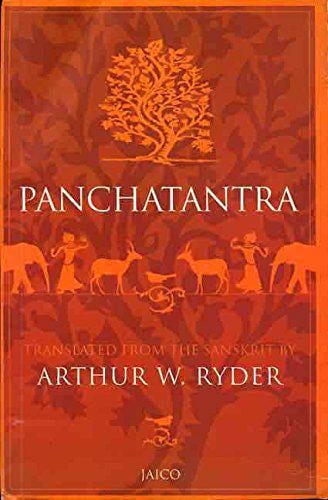
Title: The Panchatantra – Translated by Arthur Ryder/Ramsay Wood
CWs & TWs: Sexism (the book is like 2500 years old, don't expect it to like women)
Genre: Folktales & Fables
Rating: Ryder – ⭐⭐ | Wood – ⭐⭐⭐⭐
Link: https://www.goodreads.com/book/show/653244.Panchatantra
The better Aesop before Aesop was a thing. The Ryder version is at once superior and inferior to Ramsay Wood's. I found it okay though the latter is much more enjoyable.
The intended object of the Panchatantra is to educate young princes on conduct whilst ruling. Indeed kingship features heavily throughout the five treatises therein; from the pretext of the entire story (namely a king trying to educate his blockhead sons) to the numerous anecdotes of kingly (mis)conduct lodged throughout the nested tales that follow. On an academic level it is easy to see the obsolescence of this goal. Aside from monarchies largely dying out, most of us aren't princes or kings. And the few privileged enough to inhabit modern analogues to nobility can certainly do better than 2500+ year-old stories. To be fair, many of the book's lessons apply to mundane life. So should you read it to have good advice in your personal life? Timeless secret wisdom from sages long past? Probably not. There isn't a single self-help book that says anything truly unique (brazen hyperbole I am sure I will shortly be corrected on). This applies to the Panchatantra as well. We all know what we can do to make our lives better in significant ways. We just ignore them. That's right, you should be exercising more.
So why should you read the Panchatantra? Before reading the Ryder version, I would have said to do so for the characterization, wit, and unique story delivery and setting. Ramsay Wood did an excellent job modernizing and grounding the fables of the first two treatises. Vulgarity and irreverence often mixed with a highly accessible portrayal of an ancient cast, reducing the reader's mental load and slicking the pages with colloquial grease. I would still recommend it over the Ryder version. And of course, it also had some very memorable couplets…
‘I am the slave of what I have spoken, but the master of what I conceal.’
But on finishing Ryder's another facet of the work was revealed. See, the full versions of each treatise (which Ryder's is to my understanding) were often interspersed with poetry. Pithy sayings and stanzas drawn from floating vedic oral traditions. Characters go back and forth, making arguments and pulling from this pool of what I can only call sanctified memes.
Stand ever firm within,
Resolved to do or die:
So, living, earn renown;
Or dead, the starry sky.
It was not very apparent to me in the Ramsay version, but when you read Ryder and notice that almost all characters, even when not telling a story, seem to preface or follow assertions with oral tradition, everything clicks.
A hundred’s mine? A thousand, please,
Thousand? A lakh would give me ease,
A kingdom’s power would satisfy
The lakh-lord. Kings would own the sky.
The hair grows old with aging years;
The teeth grow old, the eyes and ears,
But while the aging seasons speed,
One thing is young forever — greed.
It is somewhat similar to Platonic dialogue. It predates Plato of course and is far more didactic. But there is a rhythm of conversation – spawned, negotiated and finalized – across the tales. True there is generally a lesson to be learned at the end of each treatise and story (making it not really platonic, I suppose), but interlocutors can respond with stories and poetry of their own. This is where I find it far more interesting than Aesop. The latter's fables are generally self-contained and clear in illustration. But the Panchatantra muddies the waters substantially more. Sound words and quotes can be misutilized. Tradition frequently contradicts itself because the world is complex, and you don't get to be lazy just because one or a handful of "sources" agree with you. Disinclined as I am to venerate "ancient wisdom", I think this meta-illustration is particularly potent and nice to see. It almost calls on the reader to look upon the work itself with skepticism.
For technical particulars, you would do well to consult Project Gutenberg for the original Ryder version. I read a copy published by a company called Jaico, and it was full of typos and errors. Generally jarring which is unfortunate. The characterization is somewhat weaker than the Wood version as well. This is understandable, as Ryder was attempting a faithful, scholarly rendition of the original work. Ryder was also writing decades before Wood so you can give him his flowers. But all the same. Pope's Iliad is probably my favourite Iliad, even though it's arguably the least Homeric. Sometimes accuracy and completeness are hard to convey across time and purpose in pristine form without making things dull. But I'm very happy I read both versions. Ryder sometimes stumbles into awkward rhyme schemes, but the poetry is generally welcome I'd say.
So why should you read the Panchatantra? Depending on what you want, there are two versions offering different things. A vigorous and comedic setting with spicy concentric tales? Ramsay is a good choice. General interest in the Sanskrit canon and vedic traditions, Ryder is up your alley. Are these books the best possible things you can do with your time? No. But if you're a book lover or just occasional reader, you don't need to read the best possible thing from moment to moment. If you want something interesting and light, it's not a bad choice at all. To quote:
Do not indulge in hopes
Extravagantly high:
Else, whitened like the sire
Of Moon-Lord, you will lie.”
by themanofmanyways