
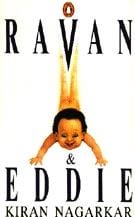
Ravan and Eddie by Kiran Nagarkar
When this book came out in 1994, it was hailed as one of the great Indian novels. An Indian book that was funny, lyrical, and not about Partition or British rule? Inconceivable!
Nagarkar started writing Ravan and Eddie first as a screenplay but when the 4.5 hour behemoth wasn't getting traction, he turned it into a novel. Interestingly, he began writing in Marathi but completed it in English. The cover of baby Ravan gleefully swandiving is by the celebrated artist Manjula Padmanabhan. It is still widely recommended today as the seminal work of contemporary Indian literature in English.
The book follows two boys, Ravan and Eddie, neighbours living in a Bombay chawl (lower income tenement housing). Nagarkar was a talented writer and his observations of Bombay and its inhabitants are often astute and hilarious. He accurately takes aim at India's colonial hangover in the craze for skin whitening creams, at the rising militant sectarian Hindu right wing that recruits young Eddie, at the realities and anxieties of the lower middle class desperate to learn English to be upwardly mobile. He doesn't hold back from poking at this city's foibles, both endearing and frustrating. I described him once as 'RK Narayanan but bitchy'.
That brings me to his biggest flaw. His writing is heavily through the male gaze, and his jokes are often cruel and mean spirited. The amount of rape and violence in this book played up for comedy is rather startling. Some of it is of children. Parvati, Violet, and any other women in the book are only accessories to the men around them. Women suffer, repeatedly, egregiously, gratuitously, throughout the book, most often for a laugh but also to drive the male characters' arcs. It is worth noting that the author faced several allegations of sexual harassment in the #MeToo movement.
His other weakness is that Ravan and Eddie, as entertaining as they are, lack distinctive personalities. They are somewhat generically mischievous little boys, getting up to amusing hijinks, and slithering out of scrapes in equally comic ways. One is Christian and one is Hindu but they're otherwise interchangeable. One gets raped repeatedly by an older classmate, one witnesses his best friend's suicide – which one was which? If you transposed Swami from Malgudi to Mumbai, he would be a third twin. Even if one made excuses for Nagarkar's poor writing of women (they are only supporting characters after all), surely the titular main characters should have unique, three dimensional, memorable personalities.
Also, I wish Parvati and Violet realised they are lesbians, kicked all the men in their life to the curb, and lived happily ever after together.
If you've read it, what do you think of it now? Have you read the sequels or plan to?
by GalatFemme