
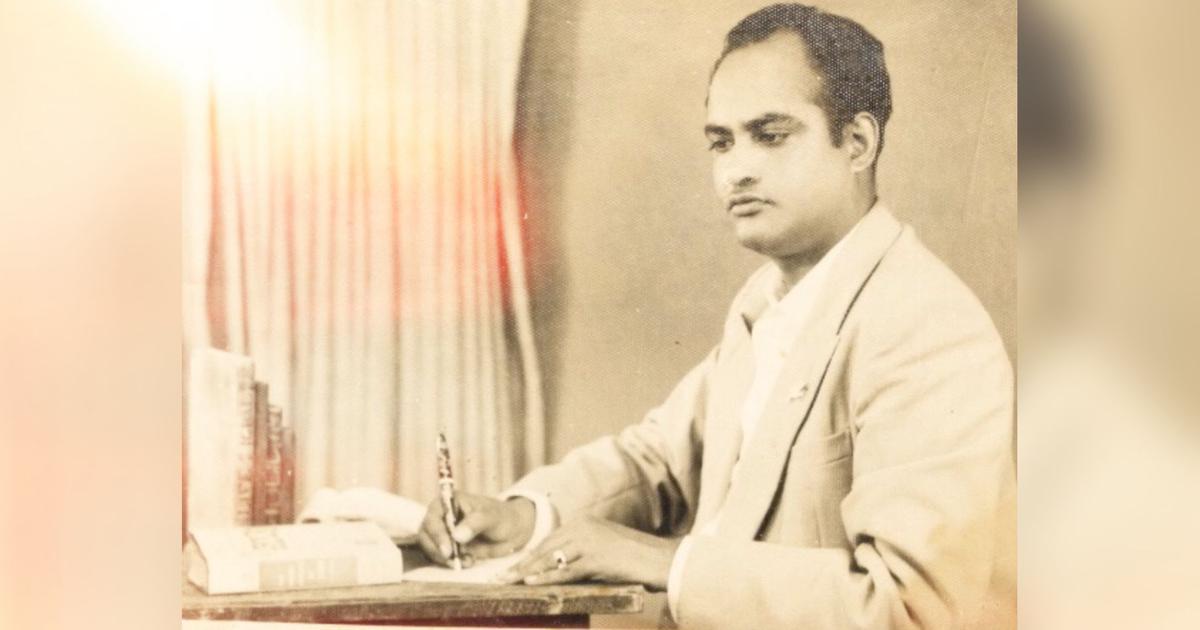
He was born as "Asrar Ahmad" into a feudal family in 1928. Though his father discouraged it, his passion for reading came naturally, and his mother ensured his education.
Jasoosi Duniya (The World of Mystery)
By the time he was 24, he had published his first novel under the pen name "Ibn-e-Safi". It was called "Dileir Mujrim" (The Brave Criminal. The novel was the first in what would be his most famous series of detective novels, "Jasoosi Duniya" (The World of Mystery/The Spy World).
Centring on the adventures of Colonel Ahmad Kamal Fareedi and Captain Sajid Hameed, the series is more Guns of Navarone meets James Bond than Sherlock Holmes.
It covers everything from political assassinations and genetic experiments to aliens and nefarious inventions by mad scientists.
Ibn-e-Safi was incredibly successful within his own lifetime. His novels, which often numbered between 150 and 300 pages, would sell out quickly among school and college students, as well as adults.
The Imran Series
Eventually, demand for his books reached such unprecedented heights that he came up with a new character, the mischievous, but razor-sharp spy, "Ali Imran". His "Imran Series" was created specifically to cater to his ravenous readers who expected new books nearly every few months.
The Imran Series featured more sensational and fast-paced plots, which Ibn-e-Safi found easy to churn out.
This gave him more time to focus on developing the "Jasoosi Duniya" novels, which became more elaborate as time went by. Eventually, he devoted 2-3 novels to a single storyline. He would eventually write over 120 novels for each of his series.
Struggles
As his popularity grew, several copycats appeared and published their own versions of his novels, hoping to profit.
In the early 1960s, he was diagnosed with schizophrenia and spent years in psychiatric care. It was said that he had become fearful of his own characters. After his treatment, he employed his past paranoia and trauma to produce more elaborate plots and characters.
In 1974, he wrote an original screenplay for a film called "Dhamaka" (Explosion). However, the film was not successful. He would blame the limitations of Pakistan's film industry for its failure. Rumour has it, his estate forbids the adaptation of his work to any medium for fear of distortion of his work.
He continued to write until he died in 1980.
Contributions
Ibn-e-Safi's contribution to Urdu is more than just his detective fiction, however.
He introduced several technical terms into the language. He also developed several equivalent terms in the native Urdu.
Novelists like "Mazhar Kaleem", who continued the "Imran Series", and "Ishtiaq Ahmed", who wrote the "Inspector Jamshed" series, both achieved their success on ground made fertile by Ibn-e-Safi.
His novels continue to sell to this day.
by colouredzindagi