
(Written for a Substack article, so I do apologise for the formality of this post lol)
This isn’t a spoiler-free review of Wild Dark Shore! So if you’ve yet to read it, or simple care about spoilers, please read this later! But do, I beg, read this book. It made me feel such grief yet such warmth — a tragedy doused in familial love.
A family battling the decay of the waves — each crash and ebb takes a little piece of them with it. A maelstrom may take something important, but it may also wash up something kind.
A family living on Shearwater was never meant to thrive, however much the daughter was born for the sea. A sub-Antarctic island home to albatross, seal and penguin; it was the home of a seed archive, a research base dedicated to preserving millions of species of seeds so that should the human race, the earth, rot, our predecessors may thrive. Endangered and less-so species sit frozen in this vault… but the world is changing, and Shearwater is drowning.
The research base must be cleaned out, but there is only space for half the species to escape. It is this harrowing decision, to knowingly kill whole species, that turned Rowan’s husband, Hank, mad… and violent.
This madness communicated through their meek emails to one another, and when finality seemed to take precedent, Rowan abandoned her fear of the water — her guilt — to find him. But the maelstrom is unbiased and the storm rages on; she washed up on the shore… and Fen Salt, a blonde-haired seraph of the deep, found her.
“There is something else drawing breath. Bravely swimming his way to the surface to find her. She will not be there to meet him, but I can be.
I can be.”
Though this novel made your author cry, the ending especially killed me, I did find it was slightly lacking in something narrative-wise. The way the mystery of Hank aimed toward Dominic having killed him was clever, but I find the outcome to be a little… I’m unsure of the word. Empty, maybe? Far-fetched? Silly? No, I wouldn’t go so far as to call it that.
It turns out his madness turned him homicidal, and after having a strange, predatory relationship with Fen, he tries to drown her. Raff and Alex (his boyfriend, a researcher who ended up hanging himself) see this and Dom ends up imprisoning him in the seed nursery, down below, away from sunlight and, well, everything.
I thought this discovery, in the last quarter of the book, was rushed. Hank eventually escapes and Fen encounters him in the boathouse. At this point, Raff is still in the lighthouse but… has a “feeling” he must go visit Fen now. That felt a cheap way to save Fen, who I am glad did not die, but was saved in a very… convenient way, if I make sense.
Alas, there are half-fantastical elements to this otherwise realistic narrative — but these are minimal, and doused in torrents of grief and mental anguish. Dom speaks to his dead wife who whispers vitriol in his ear; in the end, Fen burns what remains of her mother in order to free him from the past. Orly speaks to whispers of the dead on the wind. Shearwater, inspired by Macquarie Island, is a place where things come to die. Once more cleverly educating the reader with real life history, it touches on the horrific practices of the 19th century; most ardently, seal clubbing and penguin barrels.
(If you want information on the latter, I’d advise googling with discretion. The former is traumatic enough — and truly encompasses the most evil members of this accursed race — but the latter is just… barbaric. Horrific. Those who can harm animals and/or children for their own gain/to see suffering deserve to be given the exact same treatment. Heartless, heartless bastards).
McConaghy describes in the afterword:
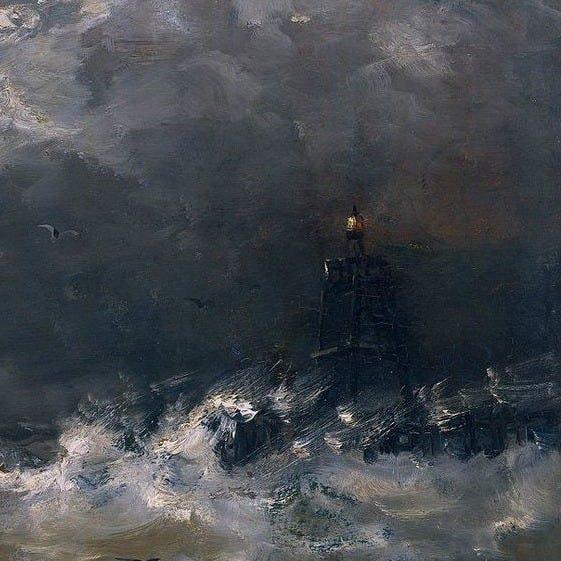
In all, this book is a book of grief. It haunts the reader, the death that the island covets; yet it warms them, the lighthouse is a shining light of hope in an otherwise damned place.
Wild Dark Shore haunts the tides of grief.
by A_b_b_o