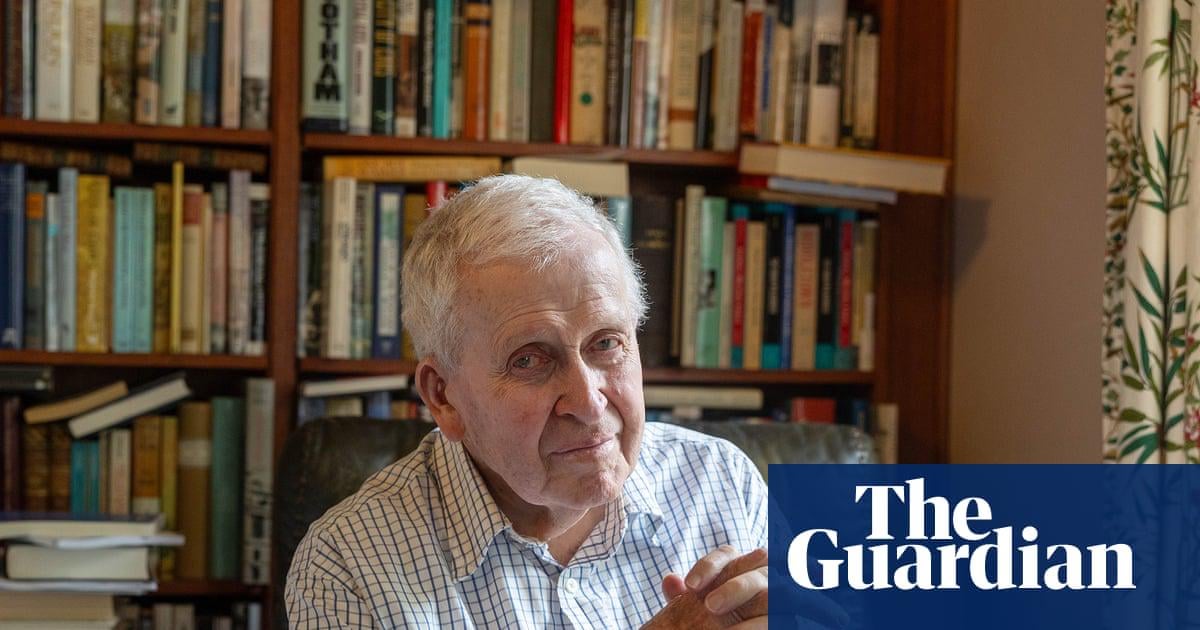
>The last time he counted, Prof Wallace Kirsop and his wife, Joan, had about 20,000 books. The floor-to-ceiling shelves lining all possible walls of their 125-year-old Melbourne house are packed full, and those volumes that don’t fit in them sit in stacks on every other available surface. Over the road, in a two-bedroom apartment the couple also owns, there are even more.
>Some of these books are hundreds of years old. But Kirsop, 92, is not a collector for collection’s sake. This is a working reference library. “The rare books are something of an extension of that. They’re mostly things I’ve worked on,” Kirsop says.
>Kirsop’s work concerns not only the contents of books but books as physical objects: who they belonged to, where they were bought and sold, the paper, watermarks, bindings, bookplates, inscriptions and annotations – all of which can illuminate history and help us understand people and the world. In English, this speciality is called bibliography – “an unfortunate term”, Kirsop says, “because people understand that just as a list of books”. His French-speaking colleagues have come up with a more apt description: “archaeology of the printed book”.
>A lifelong scholar, Kirsop undertook doctoral research on 17th-century alchemical literature at the Sorbonne in Paris and became heavily involved in the study of bibliography in Australia on his return, co-founding the Bibliographical Society of Australia and New Zealand in 1969. He was instrumental in establishing the study of rare books and the concept of special collections in Australian institutions. He taught French at the Sydney and Monash universities from 1955 until 1998 and continues to publish frequently on the history of the book in Australia and France. He is the only Australian to have ever given the prestigious annual Sandars lectures at Cambridge University.
>At the same time, he has made a career of “serial agitation” on behalf of libraries and library users, from voluntarily cataloguing French holdings at the State Library of Victoria in the early 1960s to his membership of the State Library User Organisations’ Council.
>However, with the proliferation of digital media, Kirsop notes that the skills of rare book experts are becoming scarce. “It used to be fairly standard in library schools, but it ceased to be there,” he says. He also criticizes the “new parochialism” of libraries that prioritize digital access and local works over international collections. “The argument is always, ‘well, if anybody ever wants to look at these things, we can get it online’ … But anybody studying seriously the production of any book before 1801 needs to look at as many copies as possible.”
>The importance of physical copies was highlighted in 2017 with the University of Sydney Library’s 1497 copy of Dante’s Divine Comedy. A librarian discovered a red chalk sketch by Venetian Renaissance artist Giorgione in the endpapers, making it one of the most valuable books in Australia. “Initially people in Europe couldn’t believe that such a thing could turn up in Australia,” Kirsop says.
>Kirsop is a significant donor to the State Library Victoria; an entire collection is named after him, and his remaining books are left to the library in his will. He remains critical of recent trends, such as reduced library hours and restructures that deprioritize reference librarians.
>Kirsop does not own a computer or a mobile phone. He handwrites his manuscripts and checks email once a week. “Media coexist,” Kirsop says. “These modern forms only continue to be in existence and usable if the hardware continues … Whereas the printed book is still here. The manuscript is still here. All you need is a weatherproof room to put it in and natural light to read it.”

1 Comment
>The last time he counted, Prof Wallace Kirsop and his wife, Joan, had about 20,000 books. The floor-to-ceiling shelves lining all possible walls of their 125-year-old Melbourne house are packed full, and those volumes that don’t fit in them sit in stacks on every other available surface. Over the road, in a two-bedroom apartment the couple also owns, there are even more.
>Some of these books are hundreds of years old. But Kirsop, 92, is not a collector for collection’s sake. This is a working reference library. “The rare books are something of an extension of that. They’re mostly things I’ve worked on,” Kirsop says.
>Kirsop’s work concerns not only the contents of books but books as physical objects: who they belonged to, where they were bought and sold, the paper, watermarks, bindings, bookplates, inscriptions and annotations – all of which can illuminate history and help us understand people and the world. In English, this speciality is called bibliography – “an unfortunate term”, Kirsop says, “because people understand that just as a list of books”. His French-speaking colleagues have come up with a more apt description: “archaeology of the printed book”.
>A lifelong scholar, Kirsop undertook doctoral research on 17th-century alchemical literature at the Sorbonne in Paris and became heavily involved in the study of bibliography in Australia on his return, co-founding the Bibliographical Society of Australia and New Zealand in 1969. He was instrumental in establishing the study of rare books and the concept of special collections in Australian institutions. He taught French at the Sydney and Monash universities from 1955 until 1998 and continues to publish frequently on the history of the book in Australia and France. He is the only Australian to have ever given the prestigious annual Sandars lectures at Cambridge University.
>At the same time, he has made a career of “serial agitation” on behalf of libraries and library users, from voluntarily cataloguing French holdings at the State Library of Victoria in the early 1960s to his membership of the State Library User Organisations’ Council.
>However, with the proliferation of digital media, Kirsop notes that the skills of rare book experts are becoming scarce. “It used to be fairly standard in library schools, but it ceased to be there,” he says. He also criticizes the “new parochialism” of libraries that prioritize digital access and local works over international collections. “The argument is always, ‘well, if anybody ever wants to look at these things, we can get it online’ … But anybody studying seriously the production of any book before 1801 needs to look at as many copies as possible.”
>The importance of physical copies was highlighted in 2017 with the University of Sydney Library’s 1497 copy of Dante’s Divine Comedy. A librarian discovered a red chalk sketch by Venetian Renaissance artist Giorgione in the endpapers, making it one of the most valuable books in Australia. “Initially people in Europe couldn’t believe that such a thing could turn up in Australia,” Kirsop says.
>Kirsop is a significant donor to the State Library Victoria; an entire collection is named after him, and his remaining books are left to the library in his will. He remains critical of recent trends, such as reduced library hours and restructures that deprioritize reference librarians.
>Kirsop does not own a computer or a mobile phone. He handwrites his manuscripts and checks email once a week. “Media coexist,” Kirsop says. “These modern forms only continue to be in existence and usable if the hardware continues … Whereas the printed book is still here. The manuscript is still here. All you need is a weatherproof room to put it in and natural light to read it.”